
Not Everything Needs to Be Published
A chat with Seth Werkheiser (Social Media Escape Club) about stepping away from social media, inviting friction, and building real creative connection.

[Convos] features chats with wise souls around themes of endeavor, community, and creation.
This week’s mission: Seth and I made small zines while we spoke about being creative and sharing what we make.
I once had a dream I possessed some vital information I really needed to share.
It was one of those dreams you enter mid-stream, plop straight into the frenzied center of, and the particulars are a little muddy. Maybe it was all symbolism, one of those figurative eruptions that smack you in the face after you’ve eaten some old curry or fall asleep with your AirPods on.
I was in the marina, standing in the cramped cockpit of our old boat, Macondo, the one we lived on before Lindy. We had a little pop-up table in the cockpit, a bit of varnished pomp that I preened over and got really annoyed if anyone scratched. I was leaning over the table in this dream, furiously jotting something down on loose sheets of paper.
In the way of dreams, the sheets would fly off on gusts of wind, somersaulting on currents of air out into the marina, landing on the dappled water. For some reason jet skiers were crisscrossing the main channel, shark-like, thrashing my wayward papers in their wake.
I woke up in a sweat. I’ll take a little license here, because I don’t remember this part. But let’s pretend (as we can on good authority) that the next thing I did was reach to the bedside table for my phone, whereupon I checked my feed, scanning to see if a recent post had pulled any late night likes.
Social media sucks if you’re a creative trying to share your work.
It’s easy to find people kvetching about this, but it’s much harder to find anyone offering thoughtful dialogue on why it sucks or, more to the point, what you should do instead to cultivate community and invite real relationships and genuine support around creative endeavor.
Seth Werkheiser is one of those people. Seth runs SOCIAL MEDIA ESCAPE CLUB, which is kind of like a support group for people who want to put down social media and explore other channels of connection and creative participation. Many of the peeps in his expanding orbit are professional creatives who depend on reaching audiences for their livelihood but have found social media to be, um … a really shitty avenue for that.1
Throughout our conversation, I asked Seth to join me in a small exercise: making tiny handmade zines as we spoke. It was a quirky way to slow down, to craft meaning, and to pull our work out of the abstraction of ideas and back into our hands.
We’ve been talking about just this issue at Onward, how to tell our story and bring people into thoughtful interaction with our work.2 In parallel, a lot of the structures that have supported my nonfiction writing (the feature well at glossies, traditional book publishing), while never easy to navigate or particularly lucrative, are shriveling or outright evaporating.3
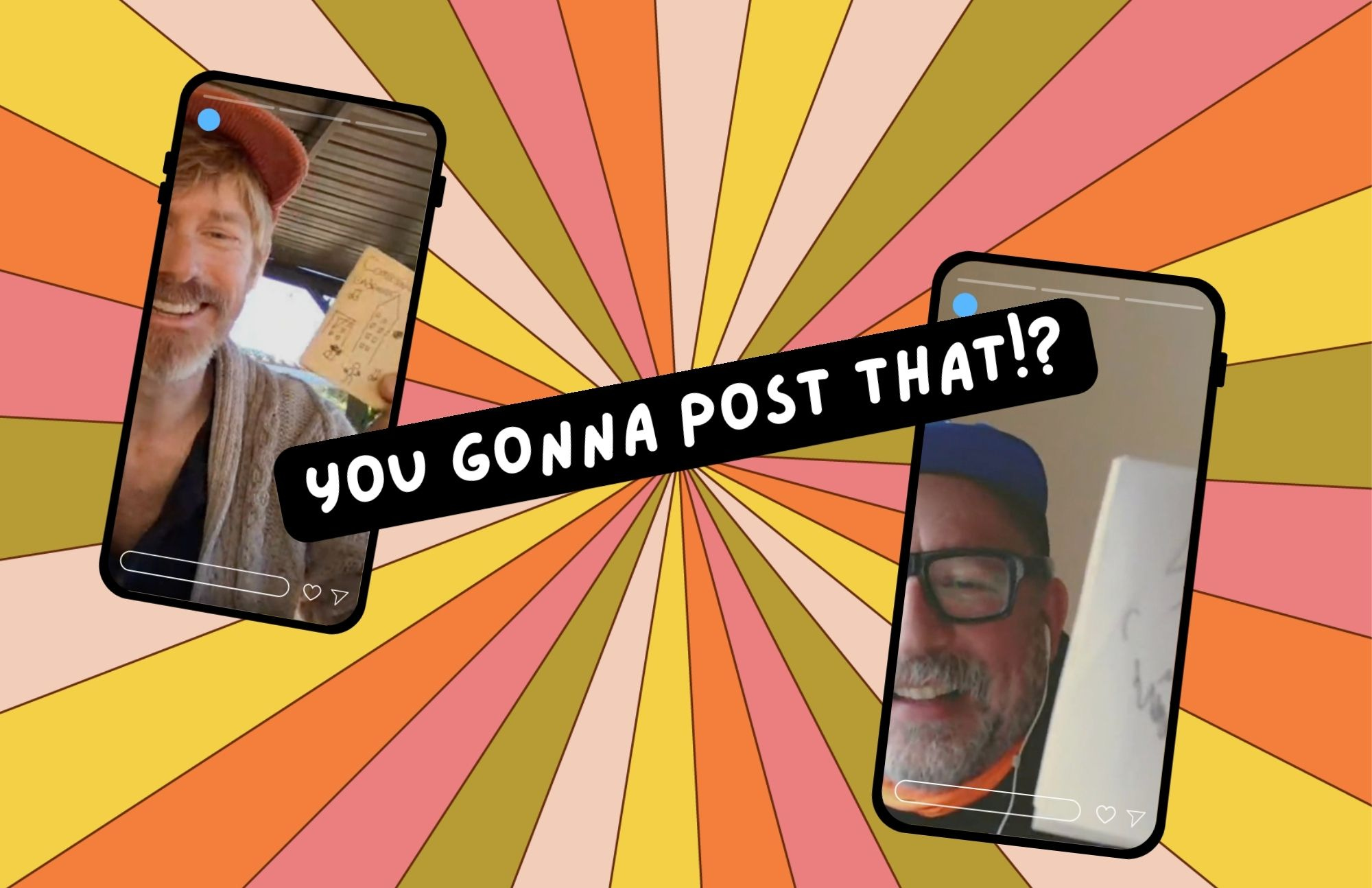
My chat with Seth ended up being one of those short interactions that inspired a notebook full of ideas. It was a slow conversation about social media, creative work, community, self-promotion, and when and how to use the digital tools that press in on us from all sides to support and foster real relationships.
Throughout our conversation, I asked Seth to join me in a small exercise: making tiny handmade zines as we spoke. It was a quirky way to slow down, to craft meaning, and to pull our work out of the abstraction of ideas and back into our hands. That little parallel exercise ended up being deeply rewarding—less “arts & crafts” and more re-orienting to what matters.
You can see the zine results below, along with highlights from our conversation and a lightly edited video. Definitely check out Seth’s work over at Social Media Escape Club, it’s worth your time.
All is offered with humility and a deep desire to connect.
To that end, if there’s someone you think would dig this post or my writing, or who otherwise might be interested in our work at Onward, forward this their way. It would mean a lot!
tl;dr (er, didn’t watch … tl;dw?)
Takeaways from my convo with Seth:
1) The trap: when life becomes a recital
One of the most suffocating parts of living online isn’t that we share things—it’s that the sharing becomes compulsory, like we’re constantly in a low-grade performance.
At some point, the inner voice shows up even in the middle of joy:
“Could this be monetized?”
“Should I film this?”
“Should I post it?”
“Would this make a good Reel?”
“How do I position this?”
And suddenly the private, nourishing thing becomes a kind of production. As Seth put it, so simply it almost feels like a permission slip:
Seth: Not everything needs to be published. Not everything needs to be out there. Not everything needs to be “building in public.”
I loved that. Because it pushes back on one of the most corrosive assumptions of our time: that if something isn’t shared, it somehow “doesn’t count.” That if something isn’t documented, it’s wasted.
Life is meant to be unmonetized, unranked, and unseen most of the time. It’s out of that stillness that real creative work flourishes, and you’re really scuffing up your contentment if your first instinct is to capture and package what might otherwise exist in playful aliveness.
2) Social media isn’t a meritocracy. It’s a casino.
This was maybe the most “helpful” moment in the entire conversation, because it reframes the emotional harm people experience online.
Seth talked about how people feel shame when posts don’t do well—like the platform is giving them feedback on their value, their talent, their legitimacy.
But that isn’t what’s happening.
Seth: People feel shame that their social media posts don’t do well… but it’s not that. People get lucky. It’s a casino.
That line punches.
If a casino makes you lose money, you don’t conclude you’re morally inferior.4 You conclude you’re in a rigged environment engineered to keep you playing.
And that’s the thing about the “content casino”: the biggest punishment isn’t invisibility—it’s how quickly invisibility gets translated into identity.
As Seth said:
Seth: For a lot of people, social media is misery — and that’s enough of a reason to not do it.
Not “misery, but still necessary.”
Not “misery, but I should be strategic.”
Just: misery is enough to leave.
Some awesome links and references from the chat!
Social Media Escape Club: Check out what Seth is up to! This links to his site and blog, which are just great.
Carly Valancy / A Good Omen: Seth references Carly Valancy as someone who speaks passionately and wisely about the art and joy of connecting (for people who think they hate networking). I’ve dug in, her stuff is fabulous and worth your time.
Kottke.org: One of the OG blogs Seth references
The Book of Zines: Get after it, zines are having a moment (again!)
3) The most damaging lie: “If nobody likes it, it must not be good.”
This part hit me hard.
Because it’s not just creative folks chasing dopamine. It’s creatives and leaders trying to determine what’s worth doing—and outsourcing that judgment to a platform that doesn’t know them, doesn’t love them, and doesn’t reward depth.
Seth spelled it out clearly:
Seth: And if the post doesn’t get likes, they think the idea isn’t worth it — which is so wrong. No one saw it.
The point:
Seth: No one saw it. It’s not that you suck.
That is such a clean antidote to a very modern psychic wound. Because we’ve confused distribution with meaning. And confused reach with worth.
The other lurking issue here: When we’re trying to win at social media, we’re doing a very different kind of work than the creative output we’re trying to share. The rigged game ends up changing our focus away from creativity into more consumable, shareable bits and bobs.
4) The escape isn’t moral purity—it’s experimenting with your attention
One thing I respected about Seth’s approach is that it isn’t preachy or brittle.
Social Media Escape Club isn’t framed like: “Delete your accounts, become pure, live in the woods.”
It’s framed like: you’re allowed to ask questions. you’re allowed to try things—quirky, creative, weird things! you’re allowed to stop doing what leaves you feeling blarg.
Seth: Social Media Escape Club is a warm welcoming place for people to question and talk about leaving social media.
This is key:
Seth: It’s not prescriptive like “do X, Y, Z and you’ll be free.” It’s more like: let’s experiment. Let’s try stuff.
That spirit—experimentation over ideology—is what makes it feel usable.
It’s not a flag you wave. It’s a practice.
5) Reclaiming friction (and why convenience is not always kindness)
This was another core insight.
The internet removed friction. But in doing so it removed something else too: the experience of seeking.
The ability to wander. To be confused. To dig. To stumble onto things by effort and curiosity rather than being served “relevant content.”
Seth said it plainly:
Seth: There needs to be an element of friction. We can’t be handheld or algorithmically fed all this cool stuff.
That one sentence contains a whole philosophy of human learning. Some friction is additive. It’s the texture of discovery. It’s how we build taste and discernment. It’s how we become ourselves.
6) The group is medicine: don’t suffer in silence
One of the worst aspects of online posting culture is how lonely it is—ironic since that’s the problem it purports to solve.
You publish. You wait.
The numbers come back—or don’t.
And whatever it stirs up in you, you deal with it alone.
Seth described it perfectly:
Seth: When you post something and nothing happens, you suffer in silence.
And then:
Seth: The group aspect… let’s stumble around in the dark together instead of isolating ourselves.
“Stumble around in the dark together” is such a humane vision of creative life.
Not “brand building.”
Not “mastery.”
Not “dominating your niche.”
Just: being a person with other people, trying to make a meaningful life.
7) A simple practice: text it to four people (and other recs)
So what *can* you do? This one is tactical, and I love it because it’s so doable. It also refocuses energy on the local, on the power of lived networks.
It’s a direct rebellion against the algorithm.
Seth: Instead of posting the link… text it to four people. See where that goes.
There’s something profound here:
you don’t need a “platform” to share meaningful work
you don’t need to perform for strangers
you don’t need to bleed yourself out into the feed
Sometimes the better path is small and relational. Think of someone who might dig what you’re doing. Say, “hey, thought you might dig this …” Boom, connection.
Here are some other specific tactical actions:
Email: This is a big one. Own your email list, curate it, grow it slowly, one person at time, and make sure the people you’re sending to open it (boot if they don’t). There’s no magic bullet, but this is how you build an audience. We’re doubling down in this direction at Onward.
Make something tactile, send it to a small number of people, ask them to engage. It’s amazing how well people respond to getting something they can look at, touch, and feel. Send a postcard, get a fan who really remembers you.
Send a letter, a physical, stamp-on-the-envelope letter. You’ll probably get a response, and that connection is so much more durable than a like.
Create an ecosystem of creativity. I started publishing longform content like this on Substack in large part because it was piling up and because I was letting ideas go fallow for lack of a reliable outlet.
Interestingly, I’m feeling the need for a separate space to put looser, shorter form, less polished work that doesn’t get blasted to everyone I know. Seth uses his blog for that, and he describes how the shorter blog posts become a sandbox for his longer writing that’s much more made for consumption. I’m keen to explore where Onward’s creativity can live, the art and stories of this vibrant group of outdoors lovers. Further, how those channels can overlap and feed into each other in ways that are additive, not confusing. Ideas? Hit me up!
8) The zine exercise (and why it felt so good)
I want to end with this because it ties everything together.
Throughout our conversation I kept returning to that little analog counterspell: zines.
Not because I think everyone needs to become a zine-maker. But the act of folding paper and sketching and jotting down notes feels so refreshingly at odds with so many modern distortions.
A zine is:
tactile
finite
slow
private (or semi-private)
made for humans, not metrics
distributed by relationship, not algorithm
It’s not optimized or polished. And that’s exactly the point.
The zine is a container that says:
this does not need to scale.
this does not need to win.
this does not need to perform.
It just needs to exist. And it puts you back in contact with something we are losing: craft.
Even a simple zine—eight panels, one page folded—becomes a tiny declaration:
My attention belongs to me.
My work is not a slot machine pull.
I can create without asking permission from an algorithm.
Closing
If any of this resonates—if you feel that subtle fatigue, that grinding sense of “I have to keep up”—I want to offer the gentlest possible encouragement:
You can experiment. You can create smaller. You can reclaim friction.
You can text four people. You can make a zine. Or not? Maybe stand on a soap box and play ukulele. I’ll watch, we can grab some tea afterward.
You can build a container that holds your work without demanding it become content.
Above all, seek out real people, not units of followers. It all grows from there.
No, really, it’s just a bad way to build audience around creative work. Even with a massive following you have vanishingly little control over who sees the stuff you’re putting out, which, it turns out, very few of your followers will on most platforms unless you pay to push.
Without paying Google or Facebook or Elon Musk any money.
I edit a magazine I cofounded around seven years ago, Truly*Adventurous. We’ve survived by eschewing advertising and, to a large extent, the need to aggregate large audiences, choosing instead to focus on excellent narrative nonfiction that has a good chance of finding success in derivative markets like film & TV development. Still, it’s nice to be read, and we’ve noticed it’s getting harder and harder to get work out there. We were getting tens of thousands to hundreds of thousands of reads on stories via newsletters and aggregators a few years back, but that’s becoming much less common—not just for us but across publishing. Everyone’s trying to figure out how to share effectively.
I’m not a gambler, in large part because I really suck at it.
Great insights.
And never heard the term 'zine' before, interesting!